
Is the Moon a Number?
The Vasin-Shcherbakov Theoryand the Cosmic Code Above Us What if our closest celestial neighbour is not a rock — but a message?
2/10/20265 min read
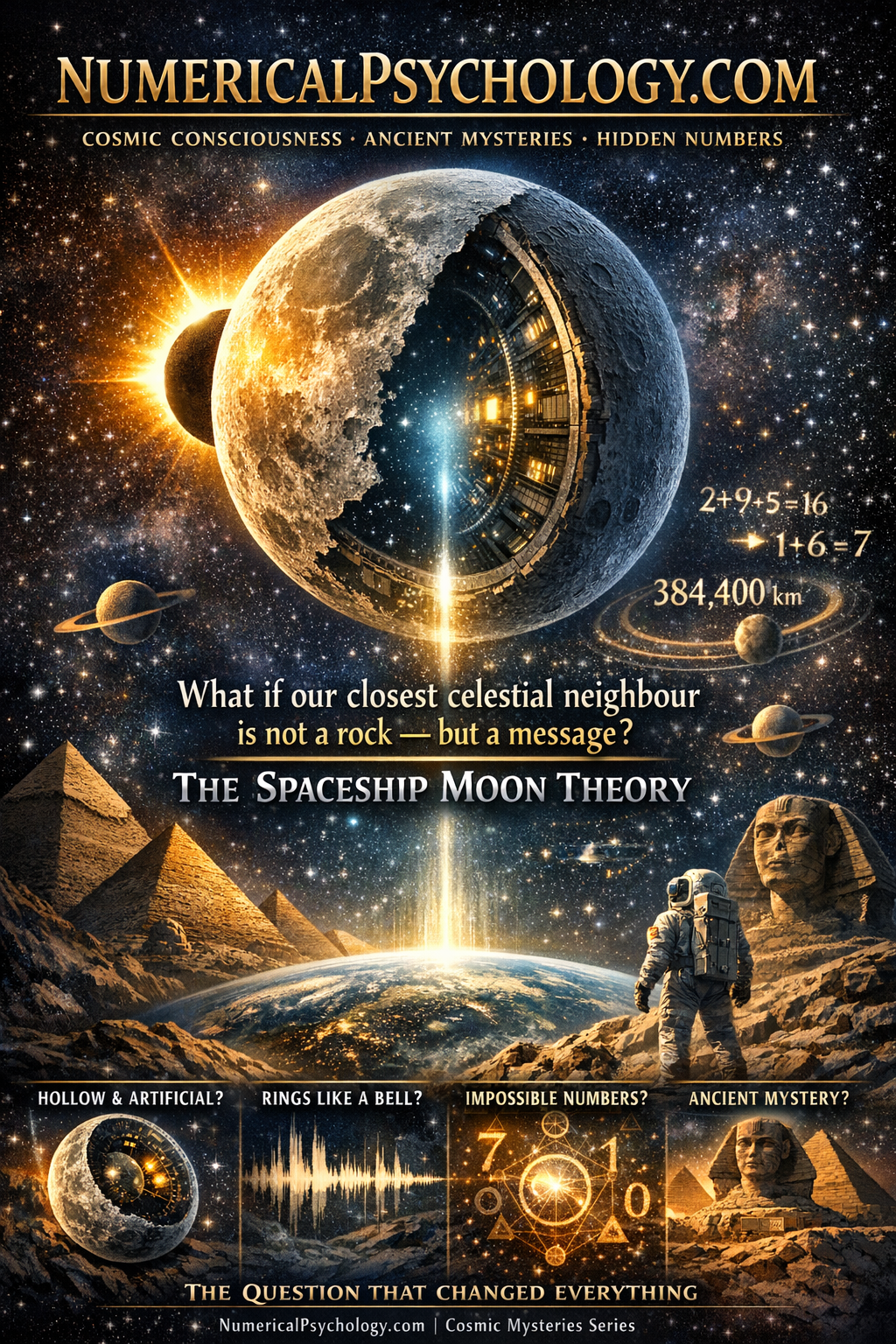
COSMIC CONSCIOUSNESS • ANCIENT MYSTERIES • HIDDEN NUMBERS
Published by NumericalPsychology.com | Cosmic Mysteries Series
The Question That Changed Everything
There is a reason the Moon has captivated numerologists, mystics, and cosmologists alike for millennia. Its 29.5-day cycle — which reduces to 2+9+5 = 16, and then 1+6 = 7, the number of spiritual completion — governs the tides, the feminine cycle, and the rhythms of life itself. In Pythagorean tradition, the number 7 is the seeker, the one who questions the hidden nature of reality. And in 1970, two Soviet scientists asked precisely that question in the most radical way possible.
Mikhail Vasin and Alexander Shcherbakov published an article in the Soviet magazine Sputnik titled "Is the Moon the Creation of Alien Intelligence?" In it, they proposed something that mainstream science dismissed — but that continues to echo through the corridors of alternative research and cosmic philosophy: the Moon is not a natural object. It is an artificial, hollow construct, engineered and deliberately placed in orbit around the Earth.
Whether you accept their theory literally, symbolically, or as a lens for deeper inquiry, the implications for your understanding of consciousness, energy, and your place in the cosmos are profound.
The Spaceship Moon: What Vasin & Shcherbakov Proposed
At its core, the Vasin-Shcherbakov hypothesis — often called the Spaceship Moon Theory — asserts that the Moon is a hollowed-out planetoid. According to their model, an advanced intelligence used enormous machines to melt the interior of a natural planetary body, forming vast cavities within it. The molten material was expelled onto the surface, creating the rocky outer shell we observe today. The result: a vessel with a dense, metallic inner hull protected by a slag-like exterior crust.
This engineered object was then, for reasons unknown, placed into a precise and remarkably stable orbit around our planet — an orbit so mathematically exact that it produces perfect solar eclipses, with the Moon appearing to be almost exactly the same size in the sky as the Sun. For those who understand that numbers do not lie, this geometric perfection is not an accident.
The Numerical Perfection of the Moon's Orbit
Consider these numbers, which Vasin and Shcherbakov found deeply anomalous:
✦ The Numbers That Should Not Exist
• The Moon's diameter is exactly 400 times smaller than the Sun's — and the Moon is exactly 400 times closer to Earth, producing a perfect eclipse.
• The Moon rotates at precisely the rate needed to keep one face permanently hidden from Earth.
• The Moon's orbital period (29.5 days) reduces numerologically to 7 — the universal number of mystery and spiritual inquiry.
• The Moon's distance from Earth (384,400 km) — 3+8+4+4+0+0 = 19 → 1+9 = 10 → 1+0 = 1. The number of origin. The Source.
The Evidence They Presented
1. The Shallow Crater Anomaly
Vasin and Shcherbakov drew attention to a strange pattern in lunar impact craters. While small meteorites create deep, cup-shaped depressions as expected, the largest craters — which should be the deepest — are instead remarkably shallow, with flat or even convex floors. Their explanation: the largest impacts penetrated through the rocky outer crust and struck a hard metallic inner hull, which arrested the depth of the crater. The surface rock is a shell over something far more solid.
2. The Moon Rings Like a Bell
During the Apollo 12 mission, NASA deliberately crashed the Ascent Stage of the Lunar Module onto the Moon's surface. Seismographs left on the Moon registered vibrations that continued for over an hour — a resonance pattern that scientists described as the Moon "ringing like a bell." Vasin and Shcherbakov saw this as confirmation of a hollow interior. A solid rock does not ring. A hollow vessel does.
3. Density Inversion
Natural planetary bodies are denser at their core and less dense toward the surface. The Moon is the opposite — its surface materials are denser than what lies deeper within. This is exactly what you would expect if the Moon were a constructed vessel: a thick, heavy outer hull protecting a hollow interior.
4. Impossible Age
Analysis of lunar rock samples returned by Apollo astronauts revealed that Moon rocks were far older than expected — some dating to nearly 4.5 billion years, older than Earth itself. In Vedic cosmology and Indian numerology, age represents depth of consciousness. Something this ancient carries a weight of accumulated energy that our instruments can barely begin to measure.
The Moon, Numbers, and Your Inner Code
At NumericalPsychology.com, we hold that the universe communicates through numbers — that every phenomenon, from the motion of planets to the patterns of your birth date, encodes information about the deeper structure of consciousness. The Vasin-Shcherbakov theory, whether taken as literal fact or as myth, points us toward a profound insight:
We are controlled by what we do not notice.
The Moon governs the number 2 in classical numerology — the energy of duality, reflection, the subconscious, and hidden influence. Its gravitational pull shapes the tides. Its cycles govern sleep, emotion, and the ebb of intuition. In Vedic astrology, the Moon is Chandra — ruler of the mind, memory, and inner world. Whether it is a natural body or an engineered one, its influence on human consciousness is undeniable and measurable.
In the numerical framework, those born with a strong Moon influence in their matrix — particularly those with 2, 7, or 11 prominent in their date of birth — often report heightened sensitivity to lunar cycles, vivid dream states, and a deep pull toward understanding hidden truths. If you are reading this article, it is likely not by accident.
What Mainstream Science Says
It is important to engage with this theory honestly. Modern science does not support the Spaceship Moon hypothesis. Seismic data gathered by Apollo mission instruments has been used to model the Moon's interior, and calculations of its moment of inertia — how mass is distributed within a rotating body — are consistent with a solid or partially molten structure, not a hollow shell. The "ringing" vibrations, while unusual, are explained by the Moon's extremely dry and rigid geology, which allows seismic waves to travel farther than on Earth.
Context also matters: Sputnik, where Vasin and Shcherbakov published, was the Soviet equivalent of a popular magazine — not a peer-reviewed scientific journal. The article was speculative from the start, and some later embellishments (claims about brass and neptunium in Apollo samples) were fabrications added by others and have no basis in reality.
None of this, however, diminishes the power of the questions the theory raises — or the value of using it as a mirror for examining what we assume, what we ignore, and what we refuse to see.
The Real Mystery: What Are You Not Seeing?
The Vasin-Shcherbakov theory endures not because it is proven, but because it asks something deeply uncomfortable: what if the most obvious, most permanent, most taken-for-granted object in our sky is not what we think it is? What if the greatest influence on human emotion and intuition is operating by mechanisms we have never interrogated?
In the language of numerical psychology, this is precisely the work of self-discovery. Your limiting beliefs, your subconscious programs, your emotional default settings — they are the Moon of your inner world. Permanent. Familiar. Influencing everything. And yet, until you turn the full light of awareness upon them, they remain hidden, operating in shadow.
Pythagoras taught that numbers are the fundamental language of the universe. If the Moon is indeed encoded with numerical precision — its orbit, its resonance, its perfect eclipse geometry — then perhaps the first step is simply to notice what has always been there, exerting its pull, just beyond the edge of ordinary attention.
DISCOVER YOUR MOON NUMBER
Add the digits of your birth day and reduce to a single number.
Born on the 25th? → 2+5 = 7. The Seeker. The Mystic. The one who cannot stop asking why.
Visit NumericalPsychology.com to do the course and explore your full numerical matrix and unlock what the numbers reveal about your inner world.
A Final Thought from the Numbers
The year Vasin and Shcherbakov published their theory was 1970. Reduce it: 1+9+7+0 = 17 → 1+7 = 8. In numerical psychology, 8 is the number of power, hidden knowledge, cosmic order, and the force that operates beneath the visible surface of reality.
Perhaps the most important question their theory leaves us with is not whether the Moon is a spaceship. It is this: what are you orbiting in your own life — what old pattern, what inherited belief, what silent program — that has always been there, exerting its gravitational pull on your choices, your emotions, and your destiny?
Understand the numbers. Understand yourself.
© NumericalPsychology.com | Explore Your Numerical Matrix at numericalpsychology.com