Jung's Apocalyptic Archetype
Numbers, Nightmares, and Renewal in 2026
2/24/20264 min read
Imagine this: It's 1913, and Swiss psychiatrist Carl Gustav Jung is on a train when a terrifying vision overwhelms him—rivers of blood flooding Europe, corpses drifting in the wreckage. Little did he know, this wasn't personal madness; it was a harbinger of World War I, straight from the depths of the collective unconscious. Fast forward to today, February 2026, and Jung's ideas feel more alive than ever. As we navigate global uncertainties—from climate tipping points to AI-driven disruptions—his "archetype of the apocalypse" offers a psychological roadmap.
But here's the twist for us at NumericalPsychology.com: Jung saw these end-times not just as doom, but as symbolic numbers unlocking transformation. Think astrological ages (Pisces to Aquarius), the quaternity of wholeness (four phases of revelation), or even his chilling "last 50 years of humanity" sketch from 1961. In a world obsessed with data and cycles, let's decode how this archetype isn't predicting our end—it's quantifying our rebirth.
The Floodgates Open: Jung's Personal Visions of Catastrophe
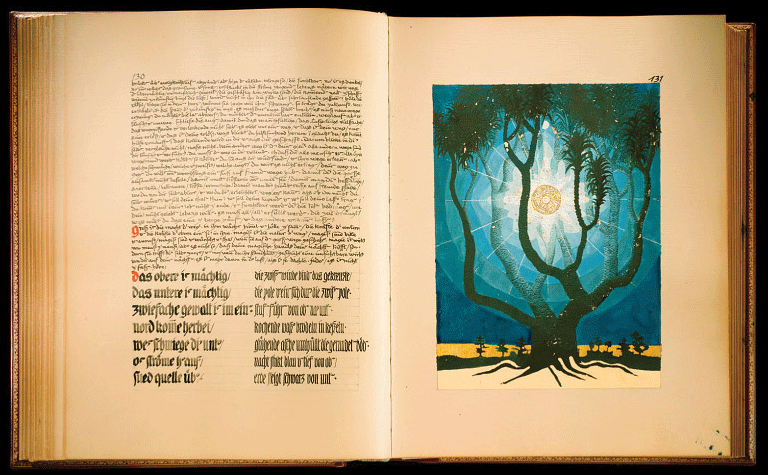
Jung's encounters with apocalyptic imagery weren't abstract theories—they were visceral experiences that shaped his life's work. In 1913, amid personal turmoil (his break from Freud), he envisioned massive floods devastating Europe, turning landscapes into seas of blood. These weren't mere hallucinations; Jung later interpreted them as eruptions from the collective unconscious, a shared psychic reservoir where archetypes like the apocalypse dwell. Documented in his secretive The Red Book (Liber Novus), these visions forced him to confront chaos as a precursor to renewal.
But the most haunting came near his death in 1961. Days before passing, Jung dictated a final vision: vast swaths of Earth devastated, yet "thank God, not the whole planet." He sketched a timeline labeled "The last fifty years of humanity," implying a critical window from roughly 1961 to 2011. For numerical psychology enthusiasts, this 50-year cycle echoes numerological patterns—5 symbolizing change and upheaval, multiplied by 10 (completion). Post-2011, we've seen escalating crises: pandemics, wars, and environmental breakdowns. In 2026, as we hit the 65-year mark (6 for harmony, 5 for disruption), Jung's warning feels like a call to integrate these numbers into our psyche for balance.
Jung didn't view death or world-end as finality. From his 1944 near-death experience—floating above Earth, glimpsing eternal wholeness—he saw the "end" as life's goal, a numerical progression toward the Self. Dreams of the dying, he noted, prepare for transformation, not annihilation. In numerical terms, it's the shift from duality (2: opposites clashing) to unity (1: integration).
Unveiling the Archetype: From Destruction to Divine Revelation
At its core, the apocalypse archetype isn't about literal doomsday—it's a psychic pattern of "uncovering" (from Greek apokalypsis). Jung spotted it across myths: Biblical Revelation, Norse Ragnarök, even indigenous prophecies. It activates when the psyche demands profound change, shattering old structures to birth new ones.
This unfolds in four archetypal phases—a quaternity Jung loved for its symbolic completeness (4 representing stability, like the four elements or directions):
Revelation: Hidden truths burst forth, like Jung's floods symbolizing repressed instincts.
Judgment: Moral reckonings, where shadows (unacknowledged darkness) project outward—think societal scapegoating or personal guilt.
Destruction: Clashing opposites (love vs. war, good vs. evil) lead to breakdown, mirroring modern polarization.
Renewal: Integration yields wholeness, symbolized by mandalas or the "New Jerusalem."
Jung tied this to the astrological shift from Pisces (dualistic faith) to Aquarius (unified consciousness), a 2,000-year cycle where numbers dictate cosmic rhythms. He warned humanity's real threat is itself: unconsciousness fueling mass destruction. Yet, with awareness, apocalypse becomes revelation—turning numerical chaos (e.g., exponential crises) into ordered growt
Edinger's Lens: Apocalypse in the Modern Psyche
Jungian analyst Edward F. Edinger amplified this in his 1999 book Archetype of the Apocalypse: A Jungian Study of the Book of Revelation. He argued we're living it now—terrorism, ecological collapse, and cultural fragmentation as unconscious manifestations. Edinger psychologized Revelation's symbols: the Four Horsemen as ego-destroying forces, beasts as inflated power, the New Jerusalem as the integrated Self.
In 2026, Edinger's ideas resonate amid "apocalyptic world situations," as Jung phrased it. Recent podcasts explore the "dark God" archetype in Answer to Job, where divine shadows demand reckoning. YouTube channels frame 2026 as a "psychic threshold" for empaths, breaking narcissistic cycles through individuation. Even the International Association for Analytical Psychology's 2026 Odyssey conference, titled "“Hope is the thing with feathers” – Imagination in Times of Despair," invokes apocalyptic imagery to foster hope.
2026: Your Personal Apocalypse—And Why It's a Good Thing
So, what does this mean for you in Rotterdam or anywhere grappling with 2026's vibes? Jung's archetype isn't a doom scroll—it's a numerical invitation. Track your dreams for apocalyptic symbols; they might signal personal cycles (e.g., 7-year itches or 28-day lunar phases) needing integration. In numerical psychology, embracing the apocalypse means quantifying your shadow: Measure anxiety spikes, journal synchronicities, and aim for quaternity balance in daily life.
Students in 2026 still find Jung's passages "frighteningly relevant," proving the archetype endures. The key Consciousness softens catastrophe. As Jung said, "The world hangs by a thin thread, and that is the psyche of man." In this Aquarian era, let's weave numbers into awareness—turning potential end into endless beginning. Dive deeper with Edinger's book or join a Jungian circle; your psyche's renewal awaits.