
Pythagoras and the Birth of Sacred Number Science
Discover who is the father of numerology and how Pythagoras created the foundation of modern numerological practice. Learn about the origins and history of numerology.
2/11/20265 min read
Mijn berichteninhoud
The Father of Numerology:
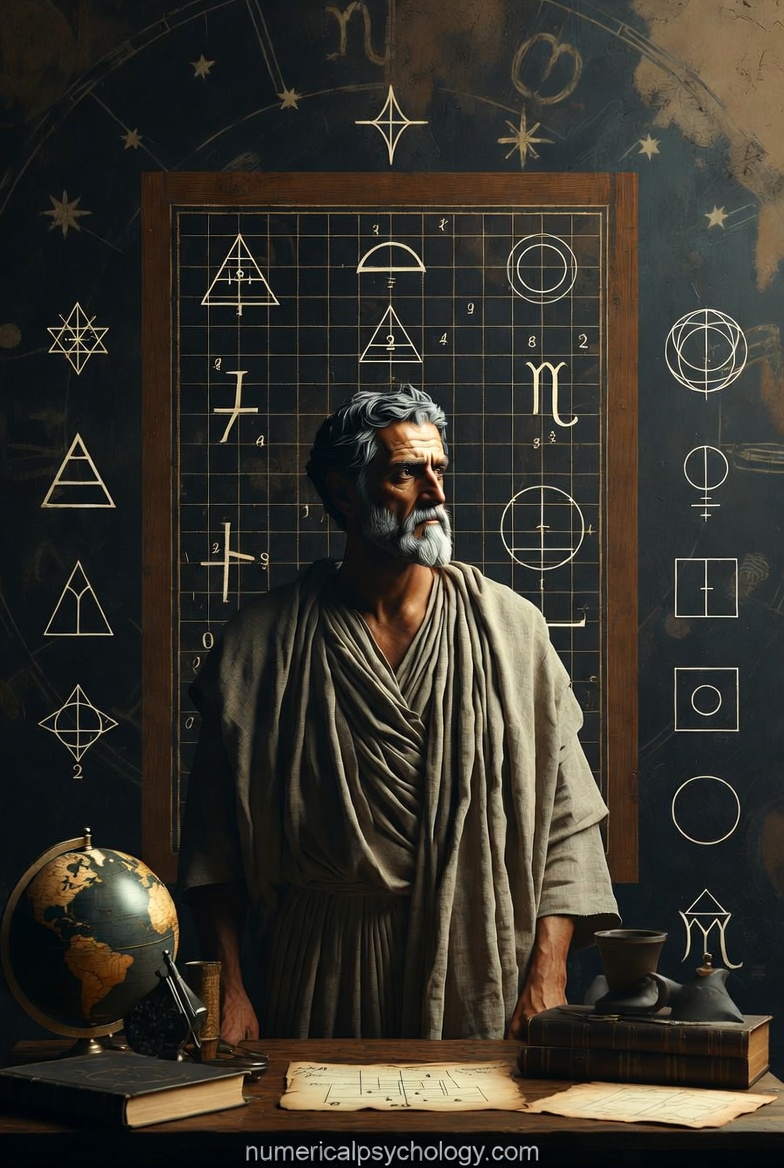
Who is the father of numerology? This question leads us to one of history's most fascinating figures: Pythagoras of Samos (c. 570-495 BCE). While many wonder who discovered numerology or who invented numerology, the answer consistently points to this Greek philosopher and mathematician who transformed numbers from mere counting tools into a profound spiritual and psychological science.
Pythagoras: The Father of Numerology
Pythagoras is universally recognized as the father of numerology, though he would have called his system "the science of numbers" or "arithmology." Born on the Greek island of Samos around 570 BCE, Pythagoras traveled extensively throughout Egypt, Babylon, and possibly India, absorbing ancient wisdom about numbers and their mystical properties.
Who created numerology? While numerical symbolism existed in various cultures before Pythagoras, he was the first to systematize these ideas into a coherent philosophical and practical framework. This is why when people ask "who founded numerology," historians and practitioners alike credit Pythagoras as the originator of Western numerology as we know it today.
The Pythagorean Revolution: From Mathematics to Mysticism
Most people know Pythagoras for the Pythagorean theorem (a² + b² = c²), but his contributions to numerology far exceed his geometric discoveries. Pythagoras believed that "all is number" - that the entire universe could be understood through numerical relationships and vibrations.
The Pythagorean theorem numerology connection goes deeper than mathematics. Pythagoras saw the right triangle as a sacred symbol representing the harmony between the physical (sides a and b) and the spiritual (hypotenuse c). This geometric relationship became a metaphor for how material and spiritual forces combine to create reality.
The Pythagorean School: Where Numerology Was Born
Around 530 BCE, Pythagoras established a mystery school in Croton, Italy, where he taught his numerical philosophy. This school became the birthplace of systematic numerology, where students learned:
Core Pythagorean Numerology Principles:
Each number from 1-9 possesses unique vibrational qualities
Numbers are living entities with distinct personalities and powers
Mathematical relationships reflect cosmic and psychological truths
Personal numbers (derived from birth dates and names) reveal life purpose and character
The Pythagorean number system reduced all numbers to single digits (1-9), plus the master numbers 11, 22, and 33. This reduction method, still used in modern numerology, was Pythagoras's innovation for making numbers personally meaningful.
The Tetractys: Pythagoras's Blueprint of Reality
Central to understanding Pythagoras as the father of numerology is the Tetractys - a triangular figure of ten dots arranged in four rows (1+2+3+4=10). This sacred symbol represented:
The Monad (1): Unity, source, consciousness The Dyad (2): Division, duality, manifestation The Triad (3): Harmony, creativity, synthesis The Tetrad (4): Material world, stability, foundation
The Pythagoreans considered the Tetractys so sacred they swore oaths upon it. This symbol became the foundation for all Pythagorean numerology, demonstrating how numbers unfold from unity into the manifest world.
Pythagoras Astrology: Bridging Numbers and Celestial Patterns
Pythagoras astrology represents another dimension of his numerical wisdom. He didn't separate astrology from numerology; instead, he saw them as interconnected systems. Pythagoras taught that:
Celestial bodies move according to numerical harmonies
Planetary vibrations correspond to specific numbers
The "music of the spheres" follows mathematical ratios
Personal destiny reflects both numerical and celestial patterns
This integration of Pythagoras astrology with numerology created a comprehensive system for understanding human nature and cosmic order. Modern numerical psychology continues this tradition, combining Pythagorean numerology with Vedic astrology and contemporary psychology.
Who Discovered Numerology? A Historical Perspective
While Pythagoras is the father of numerology in the Western tradition, the question "who discovered numerology" has a more complex answer. Ancient civilizations including:
Pre-Pythagorean Number Mysticism:
Ancient Egypt: Sacred geometry and temple mathematics
Babylon: Astrological number associations
China: I Ching and numerical divination
India: Vedic numerology and chakra systems
However, these systems lacked the systematic philosophical framework that Pythagoras provided. This is why who invented numerology as a unified discipline points specifically to Pythagoras, even though number symbolism predated him.
The Legacy: How the Father of Numerology Influences Us Today
Modern numerology, including the numerical psychology practiced today, directly descends from Pythagorean principles:
Pythagorean Contributions Still Used:
Life Path Number calculations
Name numerology and expression numbers
Personal year and timing cycles
Number reduction methods (digit summing)
Vibrational qualities of numbers 1-9
When you calculate your Life Path Number by reducing your birth date to a single digit, you're using a method the father of numerology developed over 2,500 years ago.
Pythagoras's Psychological Insights
Beyond numbers, Pythagoras understood psychology. He created the first personality typology based on numerical vibrations:
Pythagorean Number Personalities:
Number 1: Independent leaders, pioneers
Number 2: Peacemakers, diplomats
Number 3: Creative communicators
Number 4: Builders, organizers
Number 5: Freedom-seekers, adventurers
Number 6: Nurturers, caregivers
Number 7: Spiritual seekers, analysts
Number 8: Power-wielders, manifestors
Number 9: Humanitarians, completers
This system predates modern personality psychology by millennia, yet remarkably aligns with contemporary psychological frameworks.
The Esoteric Teachings: Beyond Basic Numerology
As the father of numerology, Pythagoras taught advanced students deeper mysteries:
Advanced Pythagorean Numerology:
Numerical meditation for consciousness expansion
Mathematical music therapy for healing
Geometric contemplation for altered states
Numerical prophecy through pattern recognition
Sacred architecture based on golden ratios
These practices went beyond fortune-telling or character analysis. Pythagoras used numbers as tools for spiritual transformation and psychological healing.
Modern Validation of Ancient Wisdom
Remarkably, modern science validates many Pythagorean insights:
Contemporary Research Supporting Pythagoras:
Quantum physics reveals numerical patterns in reality
Cymatics shows sound creates geometric patterns
Mathematical constants appear throughout nature
Brain waves follow specific numerical frequencies
DNA structure follows mathematical sequences
Dr. Amit Goswami's quantum consciousness theory, Dr. Masaru Emoto's water crystal experiments, and chaos mathematics all echo what the father of numerology taught: numbers are fundamental to reality itself.
Pythagoras Number: Understanding the Core Concept
The term Pythagoras number can refer to several concepts:
Personal Pythagoras Number: Your core numerological signature
The Pythagorean Sequence: The natural number progression 1-9
Sacred Pythagorean Numbers: 10 (Tetractys), 7 (perfection), 3 (harmony)
Mathematical Constants: Pi, Phi (golden ratio)
Each Pythagoras number carries specific vibrational qualities that influence personality, destiny, and life circumstances.
Who Founded Numerology: The Complete Answer
To fully answer "who founded numerology," we must acknowledge:
The Founder: Pythagoras of Samos (c. 570-495 BCE) The Location: Croton, Southern Italy The Time Period: Approximately 530 BCE The Method: Mystery school teachings combining mathematics, philosophy, and spirituality The Legacy: Western numerology systems still in use today
While others contributed to number mysticism, Pythagoras uniquely founded numerology as a systematic discipline.
Integrating Pythagorean Wisdom Into Modern Life
Understanding Pythagoras as the father of numerology isn't just historical knowledge - it's practical wisdom. Here's how to apply his teachings:
Practical Pythagorean Numerology:
Calculate your Life Path Number for core life purpose
Use Personal Year Numbers for timing decisions
Apply name numerology for self-understanding
Recognize number patterns in daily life
Meditate on specific numbers for personal development
The Father of Numerology's Enduring Gift
Pythagoras gave humanity a profound gift: a system for understanding ourselves and the universe through numbers. Whether you're exploring who created numerology out of academic interest or seeking personal insight through numerical psychology, you're engaging with wisdom from the father of numerology himself.
His teachings remind us that numbers are more than abstract concepts - they're living energies that shape our thoughts, emotions, and destinies. By studying Pythagorean numerology, we tap into ancient wisdom that remains remarkably relevant for modern psychological and spiritual development.
Conclusion: Honoring the Father of Numerology
Who is the father of numerology? Pythagoras of Samos. Who discovered numerology? Pythagoras systematized it. Who invented numerology? Pythagoras created the foundational system. Who founded numerology? Pythagoras established the first numerology school.
Every time you calculate a numerological chart, reduce numbers to single digits, or explore the meaning of your Life Path Number, you're using methods the father of numerology developed over two millennia ago. His legacy continues through numerical psychology, helping modern seekers unlock the secrets of the mind through the timeless language of numbers.
The question isn't just who invented numerology - it's how we can use the father of numerology's wisdom to transform our lives today. Pythagoras showed us that numbers hold the key to understanding ourselves and our place in the cosmos. That revolutionary insight remains as powerful now as it was 2,500 years ago.